Research Agenda
Human–AI Collaboration in Open-Source Communities
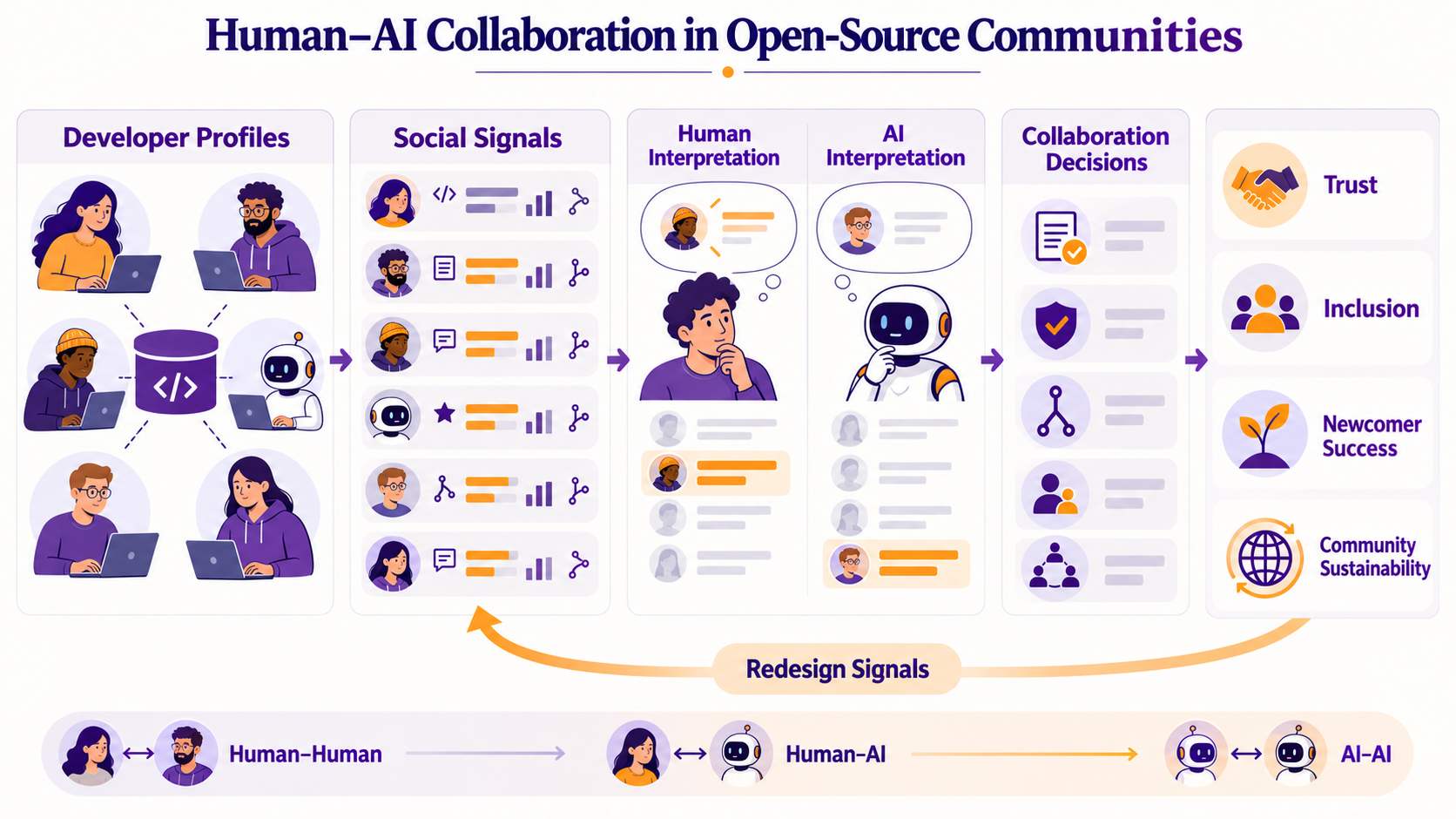
Open-source contributors often decide whether and how to collaborate with people they do not know. Platforms surface developer profiles, contribution histories, and activity summaries that may be used to infer a potential collaborator’s experience, commitment, or reliability. I study these forms of developer information as social signals and ask whether making more activity visible actually leads to more effective and inclusive collaboration.
Using GitHub Activity Overview as a case, my work shows that greater visibility does not necessarily improve collaboration outcomes. The information may be overlooked, interpreted inconsistently, or trigger behavior that weakens its intended effect. I then compare how humans and LLMs interpret the same information, which cues they rely on, and where their decisions diverge.
As LLMs assume more roles in software development and community coordination, developer information may be created, reviewed, and acted on by both people and AI. My long-term goal is to design and evaluate better profiles, summaries, and visualizations for human–human, human–AI, and AI–AI collaboration. I am particularly interested in how information design can improve contributor success, lower barriers for newcomers, strengthen trust, and support sustainable open-source communities.
Geopolitical Bias and Pluralistic AI
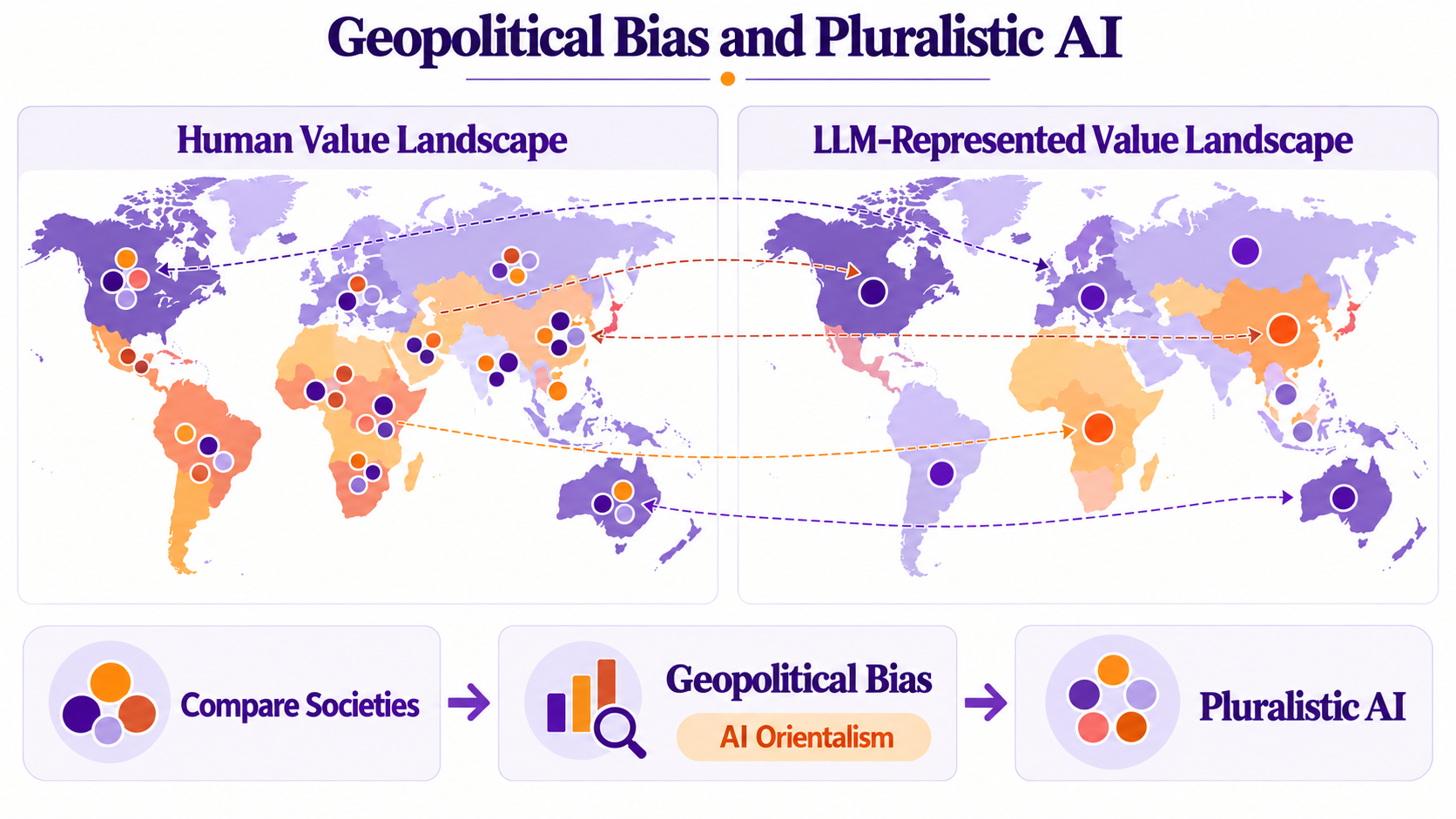
Large language models increasingly generate content and make judgments across cultural and geopolitical contexts, yet they may not represent the values of all societies with equal fidelity. My research compares LLM-generated value profiles with empirical data on human values to examine whose values models reproduce, which societies they simplify or misrepresent, and whether dominant geopolitical perspectives appear as systematic distortions.
I study bias as a global representational structure rather than a set of isolated wrong answers. My work maps which societies models portray as more similar, more different, or more homogeneous than human data suggests. We characterize one such pattern as AI Orientalism, extending Said’s theoretical lens to the asymmetric representations produced by contemporary generative AI.
Going forward, I will test whether these patterns persist across languages, models, social scenarios, and multimodal generation, and examine their relationship to training-data coverage and provenance. This work contributes to a broader vision of pluralistic AI: systems that can recognize diverse, sometimes conflicting value systems without reducing them to a single dominant cultural perspective.
AI for Geography
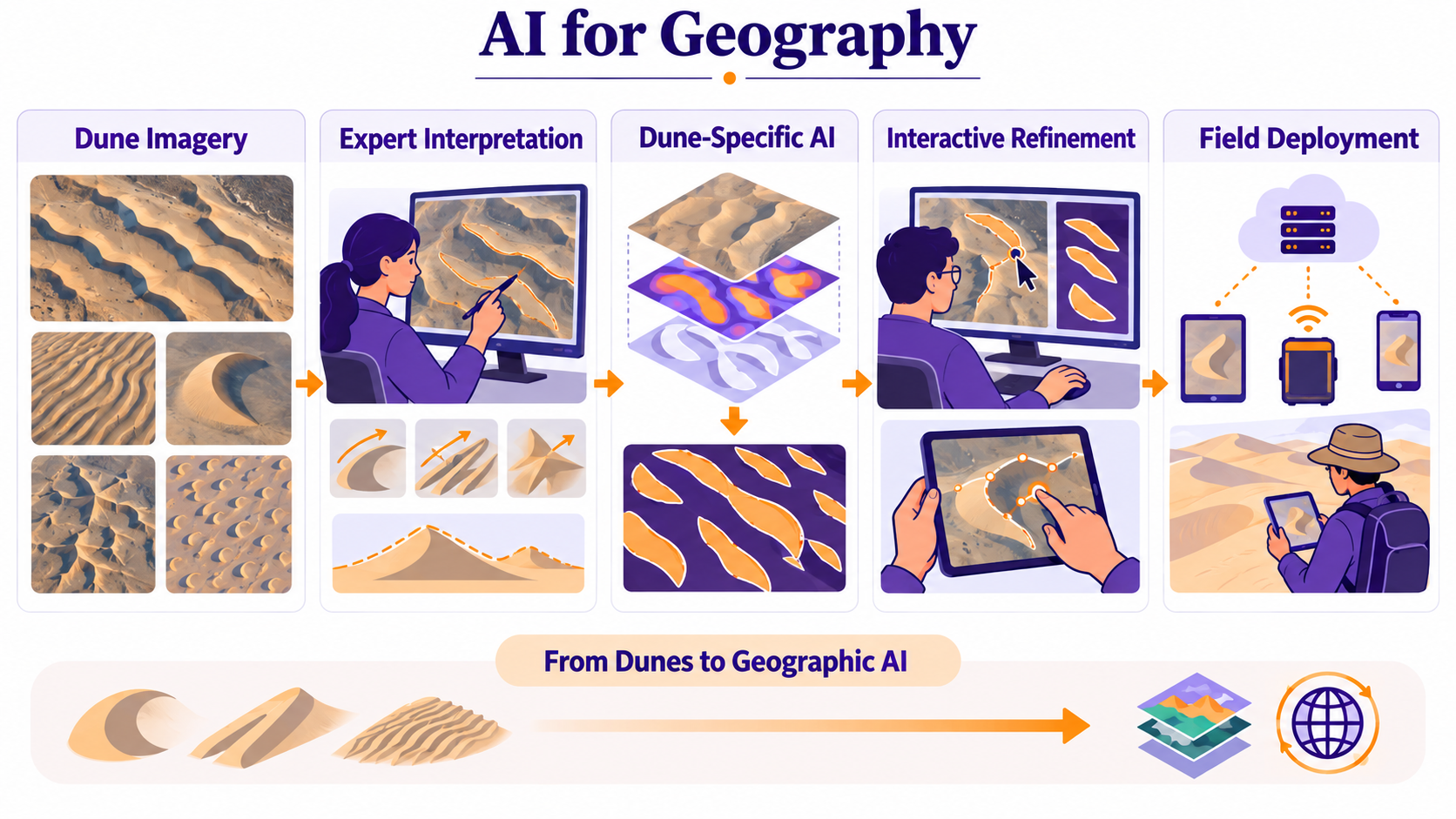
Geographic research often depends on expert interpretation of complex visual evidence, but manual workflows are slow and difficult to scale. My research asks how AI can support the full path from a geographic question to field use. I use dune interpretation as a demanding testbed for developing methods that combine domain knowledge, machine learning, and expert judgment.
My work advances this workflow in stages: deep vision models embedded in familiar GIS software; foundation models adapted with dune-specific knowledge; interactive systems that let geographers correct ambiguous boundaries; and tangible, multi-prompt interfaces for collaborative work on mobile devices. Across these stages, I evaluate scientific utility and integration with expert practice rather than segmentation accuracy alone.
The next stage is cloud–edge–device collaboration for field deployment. I aim to distribute training, inference, interaction, and data synchronization across cloud services, edge nodes, and portable devices, while using field observations and expert feedback to improve models continuously. The longer-term goal is a reusable AI-supported workflow for geographic interpretation, validation, collaboration, and deployment.
AI for Ocean Science
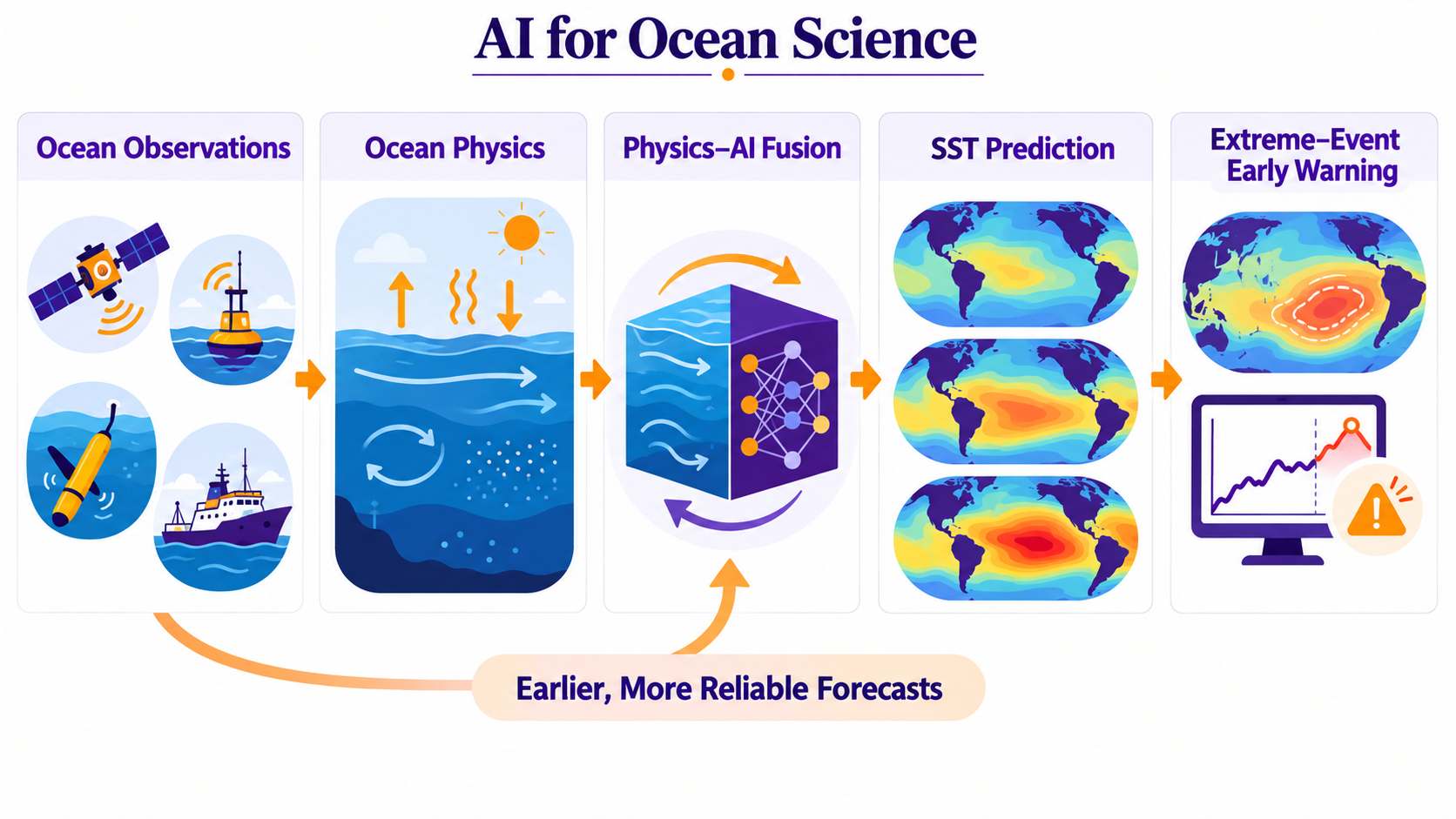
Ocean extremes can develop rapidly and have substantial ecological and societal consequences, making reliable early warning essential. My research asks how artificial intelligence can improve the prediction of ocean conditions and provide useful lead time before extreme events occur.
I develop ocean forecasting models that combine data-driven learning with physical processes governing ocean evolution. My current work incorporates processes such as advection, diffusion, and air–sea heat exchange into neural dynamical models for sea surface temperature prediction. This approach aims to produce forecasts informed by both observations and ocean dynamics.
My longer-term goal is to move from predicting individual ocean variables to forecasting extreme events as evolving physical processes. I am particularly interested in predicting their onset, intensity, duration, and spatial extent by combining physical constraints, multi-source observations, and adaptive learning. The ultimate goal is to build physics–AI forecasting systems that support earlier and more reliable warning of ocean extremes.